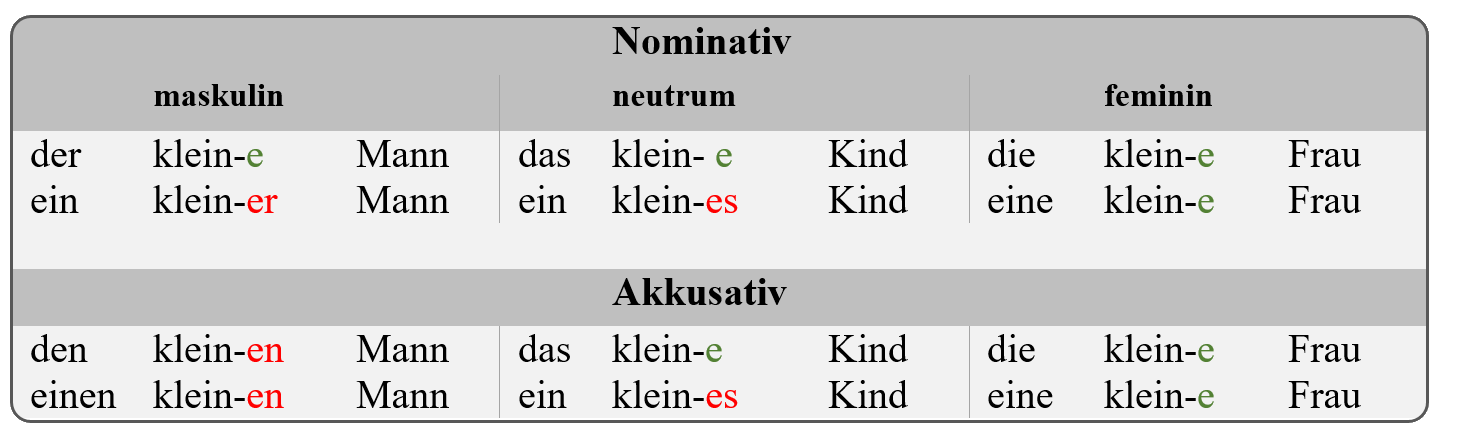
Die Adjektivdeklination mit Artikelwörtern/Declinación de adjetivos con artículo/Adjective declension with article words
- Ergänzen Sie die Endungen.
In unserem Schema kommt am häufigsten -e vor. Nur fünf Fälle weichen davon ab:
1. Nominativ maskulin mit unbestimmtem Artikel: ein kleiner Mann
2. und 3. Nominativ und Akkusativ neutrum mit unbestimmtem Artikel: ein kleines Kind
4. und 5. Akkusativ maskulin mit bestimmtem und unbestimmtem Artikel: den/einen kleinen Mann.
Übrigens, alles was danach kommt, hat die Endung -en, dazu gehören alle Dativ- und Genitivformen, sowie der gesamte Plural.
Añada las terminaciones.
En nuestro esquema, -e es la forma más común. Solo cuatro casos se desvían de esto:
1. Nominativo masculino con artículo indefinido: ein kleiner Mann
2. y 3. Nominativo y acusativo neutro con artículo indefinido: ein kleines Kind
4. y 5. Acusativo masculino con artículos definidos e indefinidos: den/einen kleinen Mann.
Por cierto, todo lo que viene después de esto tiene la terminación -en, incluyendo todas las formas dativas y genitivas, así como el plural completo.
Add the endings.
In our scheme, -e is the most common form. Only four cases deviate from this:
1. Nominative masculine with an indefinite article: ein kleiner Mann
2. y 3. Nominative and accusative neuter with an indefinite article: ein kleines Kind
4. and 5. Accusative masculine with both definite and indefinite articles: den/einen kleinen Mann.
By the way, everything that comes after this has the ending -en, including all dative and genitive forms, as well as the entire plural.
Viel Spaß beim Deutschlernen!
Dicen que el alemán es difícil,pero imposible no es!